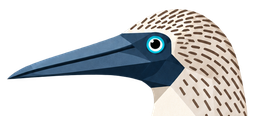
Start with North Seymour or Isla Lobos
North Seymour is a strong choice for seeing blue-footed boobies on a land walk from a Santa Cruz base. Galapagos Conservation Trust identifies it as one of the archipelago’s best seabird breeding grounds. If you are staying on San Cristóbal, Isla Lobos is the more local alternative: the Trust records it as a seasonal nesting location.
Choose a tour that actually lands and walks at the colony. Seeing boobies flying or fishing beside a boat is a different experience from observing them on land, and neither a species list nor a photograph of blue feet guarantees courtship on your visit.
Galapagos Conservation Trust: where and when to see blue-footed boobiesNorth Seymour from Santa Cruz: a walking-focused boat day
North Seymour’s visitor trail passes areas used by blue-footed boobies and frigatebirds, with land iguanas and coastal wildlife adding reasons to take the walk. Galápagos Conservancy describes shorter and longer trail loops. This is a protected-island excursion rather than a beach you can reach by an inter-island passenger ferry.
As one current supplier example, Galapagos Tours Blue Sky describes travel from Puerto Ayora by bus to the Itabaca Channel, a zodiac transfer to the yacht, a North Seymour landing and a visit to Bachas Beach. The programme is predominantly hiking, with a smaller snorkelling component. It is a better format for a birdwatching priority than a trip that only navigates past the island.
The same supplier describes a rocky and sandy trail of roughly 2 km. A dry landing still means stepping from a small boat, and flat terrain does not mean a paved path. Wear footwear suited to uneven ground, carry water and sun protection, and assess the landing and walk separately if balance or mobility is a concern. The supplier gives the meeting point the day before; staying in Puerto Ayora the previous night is our practical recommendation, not an official entry rule.
Galápagos Conservancy: North Seymour visitor trail and wildlifeIsla Lobos from San Cristóbal: walk and snorkel
Isla Lobos lets you make a birdwatching visit from Puerto Baquerizo Moreno without transferring to Santa Cruz. Choose the shore-walk version when blue-footed boobies are the main interest, rather than treating a boat circuit as equivalent.
Planet Ocean’s advertised half-day programme lasts four to five hours and includes an approximately one-hour walk, snorkelling and a stop at Ochoa Beach. Its page recommends closed shoes and lists snorkelling gear, towels, lunch, snacks and non-alcoholic drinks. Those are that supplier’s programme details, not inclusions for every Isla Lobos booking.
For a non-swimmer, the land walk may still be the useful part, but settle whether you can remain aboard during the water activity before paying. A boat-based wildlife day and a snorkelling session have different physical demands. Neither sea-lion encounters nor close bird sightings are assured.
Planet Ocean: Isla Lobos walk, snorkelling and Ochoa Beach programmeWhen are courtship and nesting most likely?
Galapagos Conservation Trust gives June to August as the typical breeding period and the best time for close observations on land, while noting that birds spend more time at sea outside breeding. Use that as a seasonal preference, not a fixed performance calendar.
There is variation between sites and descriptions. Scuba Iguana’s Isla Lobos excursion page gives a broader approximate March-to-September window for courtship or nesting. These statements do not establish one guaranteed archipelago-wide nesting season. If courtship is the deciding reason for a trip, request recent observations for the named landing site and weigh them alongside your dates; an old promotional image is not a current colony report.
The practical choice is whether to prioritise the species at all or a particular behaviour. For seeing a booby, preserve a suitable land visit in your route. For watching the high-stepping courtship display, accept that the birds may not be displaying even during a commonly cited breeding month.
Galapagos Conservation Trust: where and when to see blue-footed boobiesCompare the actual landing, not just the tour name
Before choosing between two offers, compare the named landing, walking time, road transfer, boat transfer, guide and water activity. For North Seymour, establish whether the Puerto Ayora–Itabaca road journey and the second site are included. For Isla Lobos, establish whether the programme includes the shore walk as well as snorkelling.
Do not book an expensive island change solely because a bird appears on one tour’s wildlife list. North Seymour and Isla Lobos are sensible alternatives from different bases; their departure towns are not interchangeable. A naturalist cruise can add other colony sites, but the actual itinerary and landings matter more than the boat category. None of these choices carries a sighting guarantee.
Galápagos Conservancy: naturalist cruises, hotel bases and visitor sitesPhotograph the birds without approaching the nest
Remain on the authorised trail and follow the guide’s positioning instructions. Do not step towards a nest to obtain a clear background, block a bird’s route or use flash. The Charles Darwin Foundation advises at least two metres from wildlife; allow more space wherever the current site rules or guide require it.
A long lens or binoculars lets you observe feet, eggs or courtship without changing the animal’s behaviour. If a bird moves towards the path, stop and let the guide manage the group rather than crowding it. Use authorised visitor services; nesting colonies are not places for independent landings.
Galápagos National Park: Visitor Code of Conduct, full English version